


Golfer’s Elbow Physiotherapy & Sports Injury Rehabilitation
What Is Golfer’s Elbow?
Golfer’s elbow, medically known as medial epicondylitis, is an overuse tendon injury that affects the inner side of the elbow. The pain comes from irritation and overload of the tendons responsible for wrist flexion and gripping.
Despite the name, golfer’s elbow isn’t limited to golfers. It’s commonly seen in cricketers, baseball players, weightlifters, CrossFit athletes, climbers, and people whose work involves repetitive gripping or lifting. The condition develops when repeated loading exceeds the tendon’s ability to recover, leading to pain, weakness, and reduced performance over time.
Common Causes of Golfer’s Elbow in Sport and Training
Golfer’s elbow is usually linked to repetitive or high-load activities such as sustained gripping, wrist flexion, and forceful pulling movements. Common contributing factors include repetitive golf swings or batting actions, throwing or bowling sports, weightlifting and CrossFit movements, and sudden increases in training intensity or volume. Poor technique, whether in lifting or sport-specific skills, often adds unnecessary strain to the elbow and forearm tendons.

Golfer’s Elbow Signs and Symptoms
Symptoms typically develop gradually and worsen with activity. These may include pain or tenderness on the inner side of the elbow, discomfort when gripping, lifting, or pulling, and weakness in the forearm and hand. Many people notice stiffness around the elbow, pain that can radiate down the forearm, and symptoms that flare up during or after repeated activity.
Golfer’s Elbow
Golfer’s Elbow Physiotherapy Assessment
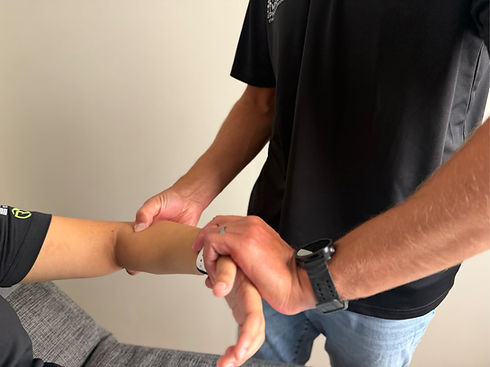
Your physiotherapy assessment focuses on identifying the true cause of the problem, not just the painful area. We assess pain location and severity, wrist and forearm strength, grip strength, elbow and wrist mobility, and shoulder, scapular, and trunk control. Training loads, work demands, and sport-specific technique are also reviewed.
Imaging is rarely required unless symptoms are persistent, worsening, or not responding to appropriate rehabilitation.

Our Golfer’s Elbow Rehabilitation Programme
Phase 1 – Pain Management & Load Modification
Early treatment focuses on reducing tendon irritation without complete rest. This may include temporary reduction of aggravating activities, hands-on manual therapy, soft tissue techniques, taping or elbow support if needed, and pain-relief strategies while maintaining safe movement.
Phase 2 – Restore Mobility
As pain settles, the focus shifts to restoring normal movement. This includes gentle wrist and forearm mobility exercises, elbow range-of-motion work, and addressing shoulder and thoracic spine restrictions that may be increasing elbow load.
Phase 3 – Progressive Tendon Strengthening
This is the most important phase for long-term recovery. Rehabilitation includes isometric exercises for pain control, followed by eccentric and concentric strengthening of the forearm muscles, grip endurance training, and shoulder and scapular strengthening. The goal is to improve tendon strength and load tolerance.
Phase 4 – Functional & Sport-Specific Loading
Once strength improves, rehab becomes more sport-specific. This includes progressive gripping and pulling exercises, return-to-sport drills such as golf swings, throwing, or lifting patterns, technique correction, and structured return-to-training progressions.
Phase 5 – Return to Sport & Injury Prevention
Before full return to sport, strength and endurance are tested, load tolerance is assessed, and an individualised maintenance programme is provided to reduce the risk of recurrence.

Golfer’s Elbow Recovery Time and Prognosis
Mild cases typically improve within 4 to 6 weeks. Moderate to chronic cases may take 8 to 12 weeks with structured rehabilitation. Long-standing or recurrent symptoms can require longer-term management. Early physiotherapy intervention significantly improves outcomes and shortens recovery time.
Prevent Golfer’s Elbow
How to Prevent Golfer’s Elbow Injuries
Preventing golfer’s elbow involves avoiding sudden spikes in training load, strengthening forearm and grip muscles, maintaining good shoulder and upper-back strength, correcting lifting or sporting technique, and performing regular mobility and tendon-loading exercises as part of ongoing training.

Is golfer’s elbow the same as tennis elbow?
No. They affect different tendon groups. Golfer’s elbow affects the inner elbow, while tennis elbow affects the outer elbow.

Should I stop training completely?
No. Controlled and progressive loading is essential for tendon recovery.
Will it heal on its own?
Without proper rehabilitation, symptoms often persist or become chronic.
Book Your Golfer’s Elbow Rehabilitation Session
Expert physiotherapy to relieve pain, rebuild strength, and safely return you to sport and training.
 835 South African rand
 760 South African rand
- 835 South African rand